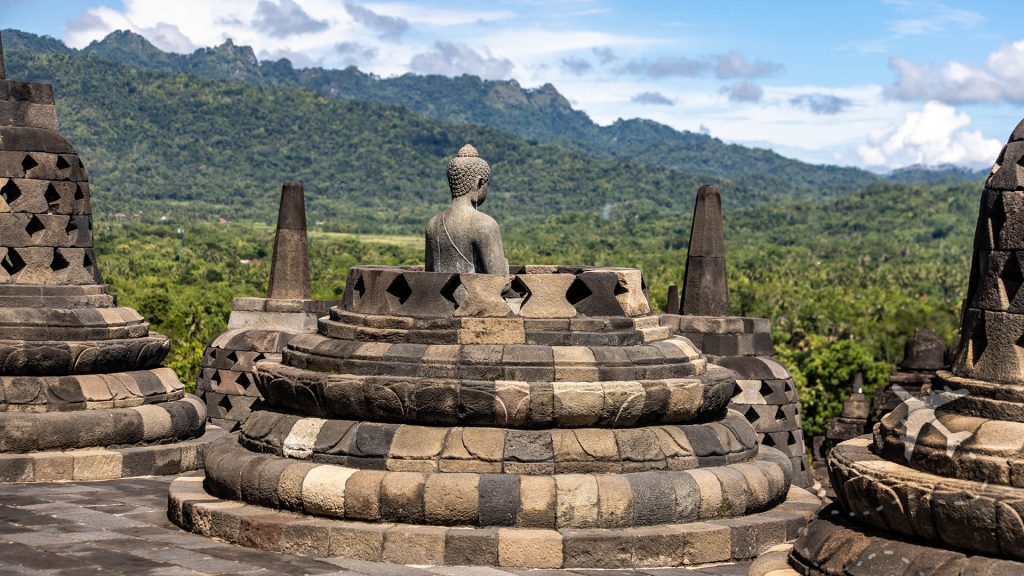
The Borobudur Ancient Wonders Comparison helps explain why this Indonesian Buddhist temple is often compared with other famous ancient monuments around the world. Built in Central Java, Borobudur represents a remarkable achievement in architecture, religion, and cultural development.
Many travelers consider Borobudur equal to famous ancient wonders because of its unique design and historical importance. However, comparing ancient monuments requires more than looking at popularity or global rankings.
Each monument has its own historical background, cultural meaning, and architectural characteristics.
Comparing Borobudur with Other Ancient Monuments
Ancient wonders around the world were created by different civilizations with unique purposes. The Great Pyramid of Giza, for example, reflects ancient Egyptian beliefs about royal power and the afterlife.
Meanwhile, Borobudur represents Mahayana Buddhist philosophy and spiritual development. The temple was designed as a symbolic journey toward enlightenment.
Unlike many ancient monuments that focused on royal authority, Borobudur combines religious teachings with artistic expression.
Visitors can explore more about Borobudur’s historical recognition through Why is Borobudur not one of the 7 wonders? The real reason explained.
Architectural Differences Between Ancient Wonders
The architecture of Borobudur makes it unique among ancient monuments. The temple consists of nine stacked platforms topped by a large central stupa.
The structure contains more than 2,600 relief panels and hundreds of smaller stupas. These elements create a combination of storytelling, symbolism, and engineering.
Other ancient wonders often highlight massive construction or royal achievements. Borobudur focuses on spiritual symbolism through its layout and artistic details.
The temple design follows Buddhist cosmology through three main levels: Kamadhatu, Rupadhatu, and Arupadhatu.
These levels represent different stages of human existence and the journey toward enlightenment.
Borobudur Compared with Angkor Wat
A common comparison involves Borobudur and Angkor Wat because both are major Southeast Asian heritage sites.
Angkor Wat in Cambodia represents Khmer civilization and originally served as a Hindu temple before becoming a Buddhist site.
Borobudur, on the other hand, was created as a Mahayana Buddhist monument during the Sailendra Dynasty.
Both monuments demonstrate advanced architectural knowledge and religious significance. However, their designs reflect different cultural traditions.
Angkor Wat emphasizes temple towers and extensive galleries, while Borobudur focuses on circular terraces and symbolic spiritual progression.
Borobudur and the Seven Wonders Concept
The Borobudur Ancient Wonders Comparison is often connected with discussions about the New7Wonders campaign.
Borobudur participated as a nominated site in the New7Wonders competition but did not become one of the final winners.
The campaign used worldwide public voting to select popular landmarks. Meanwhile, UNESCO evaluates heritage sites through professional criteria.
Borobudur received UNESCO World Heritage recognition in 1991 because of its outstanding cultural value.
This recognition demonstrates that historical importance cannot only be measured through popularity contests.
Travelers who want to experience this extraordinary monument can join a Borobudur Temple tour to discover its history, architecture, and spiritual meaning.
Why Borobudur Remains an Ancient Wonder
A monument becomes valuable because of its cultural influence, historical contribution, and lasting legacy.
Borobudur preserves important knowledge about ancient Javanese civilization, Buddhist teachings, and traditional artistic techniques.
The temple continues to attract researchers, pilgrims, and visitors from around the world.
Its importance comes from centuries of heritage rather than modern rankings.
Borobudur demonstrates how ancient societies combined engineering, art, and philosophy to create meaningful monuments.
Conclusion
The Borobudur Ancient Wonders Comparison shows that Borobudur stands among the world’s most remarkable ancient monuments.
Although it is not officially listed as one of the New7Wonders winners, Borobudur remains a global cultural treasure.
Its unique architecture, Buddhist symbolism, and UNESCO recognition prove that its value extends beyond any ranking system.