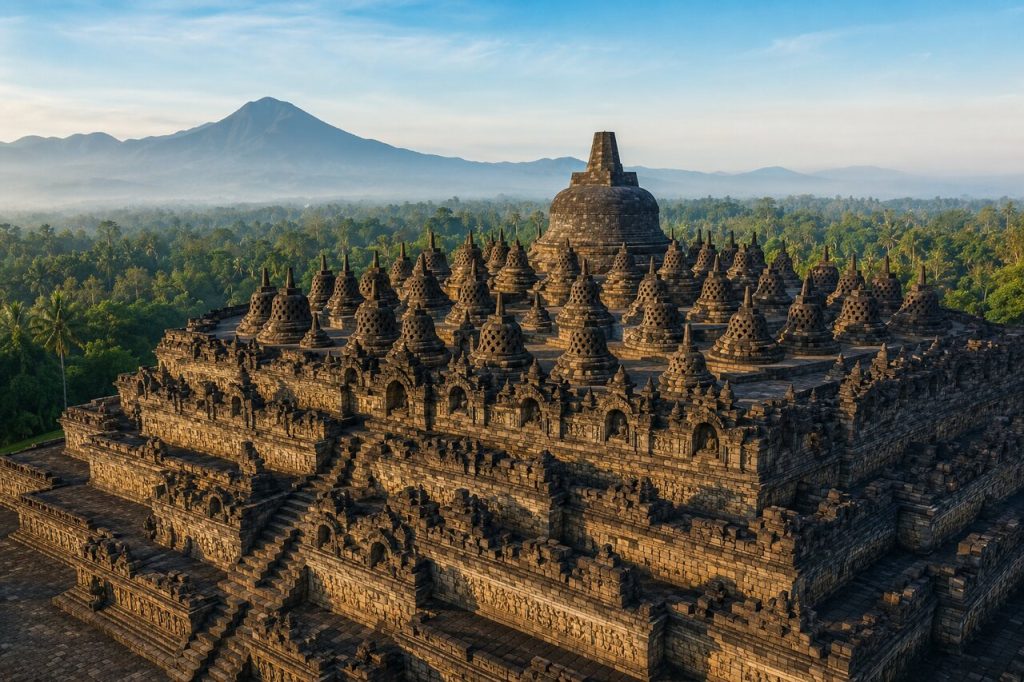
A Borobudur Temple Architecture Guide helps travelers understand the incredible design behind one of Indonesia’s most remarkable heritage monuments. The temple represents a combination of ancient engineering, Buddhist philosophy, and artistic creativity that has fascinated visitors for centuries.
Borobudur attracts travelers because of its unique structure, detailed stone carvings, and spiritual atmosphere. The monument offers more than a visual experience because every architectural element contains historical and philosophical meaning.
For travelers aged 25 and above, exploring Borobudur architecture provides a deeper understanding of Indonesian heritage. Learning about its design allows visitors to appreciate the monument beyond its impressive appearance.
Understanding Borobudur Temple Architecture
The Borobudur Temple Architecture Guide begins with understanding the basic structure of the monument.
Borobudur was built around the 9th century during the Sailendra Dynasty. The temple follows a traditional Buddhist architectural concept called mandala, which represents the universe and spiritual journey.
The monument consists of three main sections: Kamadhatu, Rupadhatu, and Arupadhatu.
Each section represents a different stage of Buddhist philosophy. Together, these levels create a symbolic path from the human world toward spiritual enlightenment.
Visitors can explore more about Borobudur’s history and architectural meaning through this complete guide to Borobudur inside structure, reliefs, and spiritual meaning.
The Unique Structure of Borobudur
Borobudur features a square base combined with circular upper levels. This design creates a gradual transition from physical space to spiritual space.
The lower levels represent the material world, where human desires and daily struggles exist.
Meanwhile, the middle levels display hundreds of relief panels that describe Buddhist teachings and stories.
The upper levels contain circular terraces with seventy-two stupas surrounding the central dome. These elements represent the final stage of spiritual achievement.
Furthermore, the symmetrical design demonstrates the advanced knowledge of ancient Javanese builders.
The Role of Reliefs in Borobudur Architecture
Stone reliefs form an essential part of Borobudur’s architectural identity.
Thousands of carved panels cover the temple walls. These carvings illustrate Buddhist teachings, moral lessons, and scenes from ancient Javanese society.
The reliefs were not created only as decoration. They function as visual storytelling that guides visitors through Buddhist philosophy.
Additionally, the detailed carvings provide valuable information about ancient culture, clothing, transportation, and daily activities.
Ancient Engineering Behind Borobudur
The construction of Borobudur demonstrates remarkable architectural skill.
Ancient builders arranged millions of volcanic stones without modern technology. The structure was designed to withstand environmental conditions, including heavy rainfall and earthquakes.
The drainage system also shows advanced engineering knowledge. Hidden channels and stone pathways help control water flow around the monument.
These features demonstrate the intelligence and creativity of ancient civilizations.
Experience Borobudur Architecture Through a Guided Visit
Exploring Borobudur with a local guide can provide a richer experience. Guides explain the meaning behind architectural details, symbols, and historical stories.
Moreover, guided visits help travelers understand why each part of the monument was designed in a specific way.
Visitors who want a comfortable cultural journey can explore private Yogyakarta tours with local guides and customized travel plans.
Discover the Meaning Behind Borobudur’s Design
A Borobudur Temple Architecture Guide reveals how every structure, carving, and level carries important cultural meaning.
Borobudur is not only an ancient monument but also a masterpiece that connects architecture, spirituality, and history.
Plan your Yogyakarta journey and discover the extraordinary architectural beauty of Borobudur Temple.